Research
The overarching theme of the group is to apply radio astronomy observations to the goal of learning about cosmology.
Our current focus is on 21 cm cosmology and using the 21 cm line of neutral hydrogen as a probe of the epoch of reionization and the cosmic dawn.
Current areas of activity include:
Simulation Based Inference for SKA-LOW
A key challenge for understanding the epoch of reionization with 21 cm observations is the non-Gaussian nature of the signal. Ionized bubbles and heated regions make features in images that are not well captured with simple statistics like the power spectrum, but which contain significant useful information. Describing those features typical requires new summary statistics with poorly undestood likelihoods. Simulation based inference (SBI) is a technique for using a detailed forward model of signal + instrument to implicitly define the likelihood and enable Bayesian inference. The group is working with SBI in a variety of contexts both to explore new summary statistics and to develop new techniques for SBI.
Detecting the global 21 cm signal with REACH
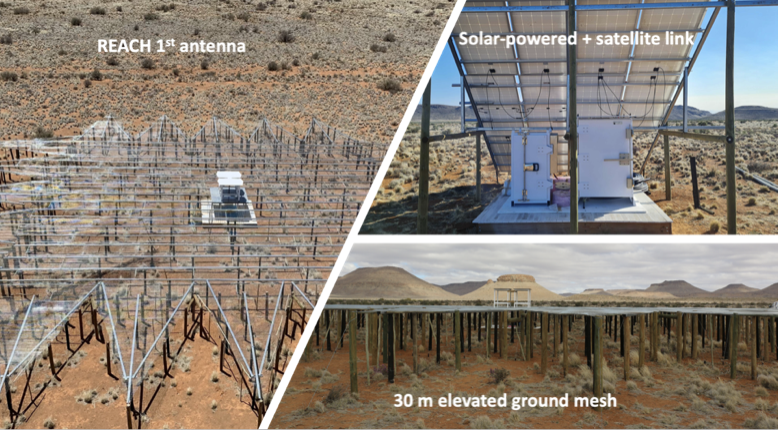
The REACH project aims to make a calibrated measurement of the 21 cm global signal using a low-frequency antenna deployed in the South African Karou. This project is led by Profs Eloy de Lera Acedo (Cambridge) and Dirk Villiers (Stellenbosch). The philosophy of REACH is to (1) build and implement a complete model and Bayesian inference pipeline for the instrument and (2) to deploy multiple antenna of different design to control systematics. REACH has been deployed in the field since 2024 and now has a year of good on-sky observations. Our group is involved in the data analysis and inference parts of the project.
Line intensity mapping x 21cm with SKA and CCAT
We are affliated with the Dynaverse Excellence Cluster, which spans University of Bonn, University of Cologne, MPIfR, and some other institutions. The focus of the cluster is “Our Dynamic Universe”, and we are involved with a project exploring synergies between SKA and CCAT for better understanding the epoch of reionization.